古代的人们更追求“意”,而现代则追求“形”,但如果没有了“意”作为根基,徒有其“形”的设计将只是一个干巴巴的空壳。字体也是同样,在由古代向现代的转变时,日本既继承了前人的成果并用现代的理论加以研究,又在此基础上使其向更加“现代化”努力。当中国回来后,已经无法理解日本的字体为何做成如此模样,只好一味的将结果照搬过来。
近年来越来越多的人认识到了对文化追根溯源的重要性,如同此次「回到中国」展的主旨:并不是倡导回到过去的中国,而是当我们的视线在国外转了一圈以后,回到对本土传统文化的关注。我们要做的并不应该是翻天覆地的改革,而是好好的继承,只有将过去研究透彻了,才有未来。
]]>- (Speech on ‘Mandarin must replace dialects as the mother tongue’ on 25 October 1981, by Singapore’s Prime Minister Lee Kuan Yew, Singapore Chinese Chamber of Commerce 1991)
According to the Government, Singapore’s lack of progress, particularly amongst the Chinese Community, was largely due to the use of dialects creating an incoherent and divided society. To tackle the problem, the Government introduced the Speak Mandarin Campaign (SMC) in 1979, which effectively signalled the beginning of the death of dialects.
One of the many Speak Mandarin Campaign slogans
THE BEGINNINGS
Singapore’s many Chinese dialects (Hokkien, Cantonese, Hakka etc.) came about as a result of early settlers arriving from various provinces in China.
In the 1950s & 60s, Singapore, like many de-colonised countries, began a search for an independent national identity. The Chinese in particular, turned to the cultural products of film and music from Hong Kong as a source of inspiration. The fascination with Hong Kong was also seen as a reactionary and feudal ‘Yellow Culture’ that was set out to oppose the ‘Red’ culture still apparent in Communist China.
Canto-pop in particular, boomed because of its apparent lack of censorship and ‘sexy songstress’, and made its way to the hearts of Singapore with popular Hong Kong singers taking centrestage at the Republic’s newly established culture centre, the National Theatre.

Cantopop made its presence felt in Singapore even before the Four Heavenly Kings.
THE GOVERNMENT STEPS IN
However, Singapore’s continued emphasis of bilingualism upon independence was becoming more apparent in both schools and the media, and this led to ‘actively discouraging’ the use of dialects championed through the Speak Mandarin Campaign, with then PM Lee going as far to say that ‘ Chinese Singaporeans below the age of forty who speak dialect will the last in queue (in government departments)
Some slogans throughout the years of the Speak Mandarin Campaign include
华人讲华语,合情又合理 (Mandarin’s In. Dialect’s Out – 1983) and
常讲华语,自然流利 (More Mandarin, Less Dialect. Make it a way of life – 1989)
Some of the first steps on the emphasis on Mandarin by the Government included the removal of popular Cantonese programmes from television and radio stations, most of which were state owned. By 1981, they were phased out, much to the displeasure of even non-Cantonese Singaporeans.
Even up till today, the Media Development Authority(MDA), states that on National Television, ‘All Chinese programmes, except operas or other programmes specifically approved by the Authority, must be in Mandarin. Dialects in dialogues and songs may be allowed provided the context justifies usage and is sparingly used.
None of this is more perhaps more apparent in the movie Army Daze, where Malcolm and gang frequently tell the hokkien spewing character Ah Beng to ‘讲华语‘ (speak Mandarin).
DIALECTS WELCOMED BACK?
Dialects however received some reprieve in 1991 when the PAP lost four constituencies during the General Elections. One of the reasons cited for poor results being the use of dialects by Opposition leaders reaching out to the Chinese voters.
Many also saw the Speak Mandarin Campaign as a propaganda effort to alienate a large section of the working-ethnic Chinese who still predominantly spoke in Dialects.
The Government then stepped it and although they never actively promoted the use of dialects, they stopped shoft of discouraging it and even allowed TVB, the Hong Kong Cantonese station to be shown on cable television in 1995.
Even the Prime Minister himself has been seen using dialects phrases in many National Day Rallies, none perhaps more famous than his statement one should order mee siam mai hum.
The effects of the Speak Mandarin Campaign were however already evident, with the population of households now increasingly using less dialects and more Mandarin.
|
Language Spoken at Home Among Chinese Resident Population in Singapore[30] |
|||||
|
Predominant Household Language |
1957 (%) |
1980 (%) |
2000 (%) |
||
| English | 1.8 | 11.6 | 23 | ||
| Mandarin | 0.1 | 10.2 | 35 | ||
| Chinese Dialects | 97 | 81.4 | 30.7 | ||
THE IMPORTANCE OF DIALECTS
Dialects however represent a truly cultural link and experience for many, the deterioration of which has led to a comprehensive lack of communication between the elderly and their grandchildren.
The beauty about dialects, just like any other language, is that it is able to emote a certain feeling through it words that no dubbing or subtitling is able to accomplish.
It also surprising that the Government, with its constant strive for racial harmony, actually saw the Speak Mandarin Campaign as a way to improve cohesion in the community and not a tool for economic progress and trade relations with the increasing power that was China.
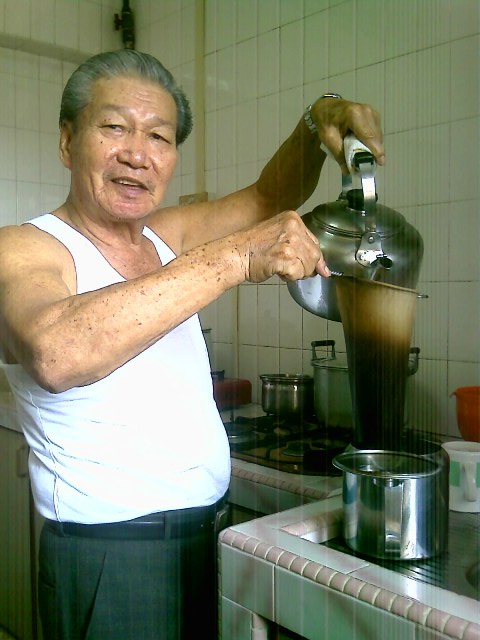
Nothing really beats walking into a dim sum restaurant and hearing the waiters shout to each other in Cantonese, trying to understand what your grandparents say, or simply even telling the coffeeshop uncle that all you want is a nice cup of ‘teh siu dai (tea with milk but less sugar). Dialects should be here to stay and is one of the few things we should not let any form of education or state run campaigns intervene in.
]]>
In course of my own actions, I have come to discover the importance of Will Energy. By Will Energy I mean willpower, determination, and how much you want to accomplish something. There is an infinite and also finite amount of Will Energy in people. There is also an important relationship between Physical and Will Energy. Let me explain.
I have come to realize that when a person is inspired to do something, even without physical energy or resources, that thought or that goal or his drive will propel him to find a way, or even re-allocate resources whether within himself (like his own body) or from without. For example, a person who is unable to complete a 5km run would, because of determination, will himself to complete it by borrowing his body’s future resources, and then suffer the consequences later (by sleeping of course.) By nature I guess our bodies pace our resource consumption so that we don’t overwork our bodies and have enough for the whole day. But Will Energy can change this.
Similarly, if we take it on a larger scale, Will Power can provide the loan of a month of resources and re-allocate them to a single use when the moment arises. Or a year. Or a century. Which allows people to do great things when they are determined. Things beyond their reach.
Which is why inspiration is so important. That hot-blooded passion to do something can change everything and turn all things to flow in your direction. The harder problem is not physical energy, but rather the lack of Will Energy. It is not easy to sustain determination or passion or inspiration. Once that whithers, so does physical energy. That is why there is a tremendous amount of inspirational blogs and social sites such as Pinterest and Dezeen. And also inspirational movies and documentaries. These serve as Will Energy replenishing sources so that people can sustain their passion and not get bored of whatever they are doing. In other words, staying inspired.
So why is it finite and infinite at the same time. I guess by finite I mean that it does run out easily, and especially in this age of information when we are constantly bombarded by the internet, nothing interests us for very long anymore and we run out of inspiration to do anything. Infinite because if you know how to tap into that energy within, you have an infinite supply to draw from. It is a game-changing energy that comes from within and one must learn to recognize and draw it out. Much like the Nine-tails in Naruto (pardon my anime reference). Which is why people with lots of WIll Energy and know how to harness it inevitably become leaders of our time, such as Obama, because they are constantly able to fuel people’s thoughts and hope, to push them to see beyond the current state, and to provide vision for the future. They propel humanity, change society, and drive us to the next level.
That is why it is always important to stay inspired.
]]>No I’m not criticizing the government housing in Singapore, but yet I am. I have first-hand experience of what it feels like, growing up 21 years in a HDB neighbourhood. Yes, it is a great solution. Being a small island, it solves the problem of space, becoming a vertical street that floats in the air, and being modular, it can be cheaply fabricated and duplicated, again and again, and again and again. This provides affordable housing for everyone, a privilege that Singaporeans do not understand how lucky they are to have. If they ever traveled elsewhere, such as China or even the States, they will realize it isn’t as convenient elsewhere. So I’m grateful for what it is and its purposes. But here I have to stop my praises and be critical for what it is, for I am a child of my land, and one can’t help but point out the consequences of such a model.
The quote in Urbanized showed a building in New York, probably built during the time of Robert Moses, not unlike the HDB flats in Singapore, and remarked that such buildings destroyed the framework of a community, because it prohibited interaction between the neighbours. In traditional times when we still had villages or towns, when everything was more or less flat, people could see what was outside their house, and would sit outside too. There were open spaces where children could play, and people are rather visual; they associate with what they see, and over time, they recognize neighbours, they start chatting and everyone becomes a community. Such is lost in the modern high-rise. Nowadays, residential blocks are cold and inhumane, filled with dark corners that people are afraid to go to. Few talk to each other, because the balconies are so narrow, and for some reason, people feel like trouble is looking for you when strangers knock on your door. There is no more public space near the living areas save for the playgrounds downstairs. And even so, space is wasted because the journey along the balconies and vertically through the lifts have become purely functional for getting from point A to point B, whereas back in the day, the journey home is also the journey to greet and interact with the community. The points of interaction in HDB heartlands in Singapore now are only in shopping malls, churches, playgrounds (which are usually deserted now), coffee shops (known as kopitiams) and schools. Other than these touchpoints, the residential areas are basically stark and provide only a singular function: for you to rest at home with your family. Hence I have grown up without knowing most of my neighbours, although luckily for me, we were at the unit beside the elevator, and people always had to walk past our door to get there, so they would sometimes say hello. I knew most of the shopkeepers downstairs my block, and even after 7 years of absence, they would still give me a smile or a nod when they see my face on my visits back home. That was the little warmth I could get out of communal living, but it’s even colder now as most HDB flats don’t have shops at the base but only cold empty void decks. This is why you have an international community in Singapore, with multi-cultures and multi-races living in the same block and on the same street, but yet no sense of community in the residential areas, and hence no sense of belonging. You do, however, feel a sense of belonging to organizations and institutions such as schools and workplaces.
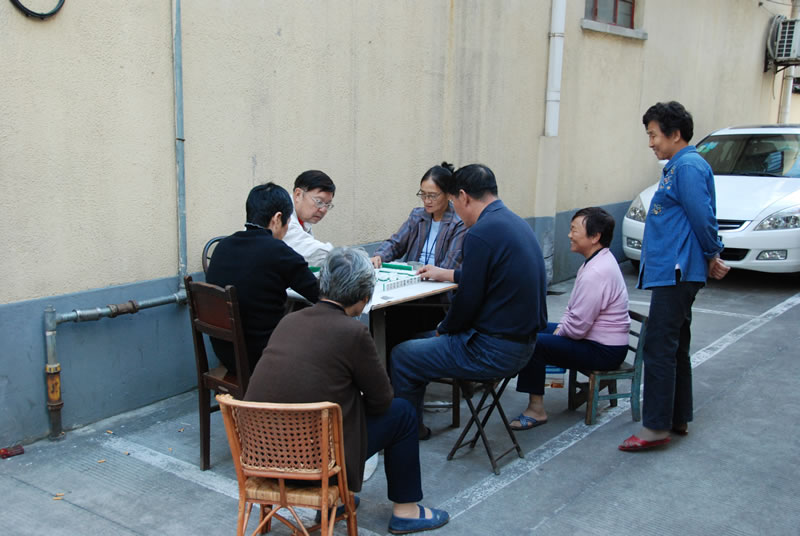
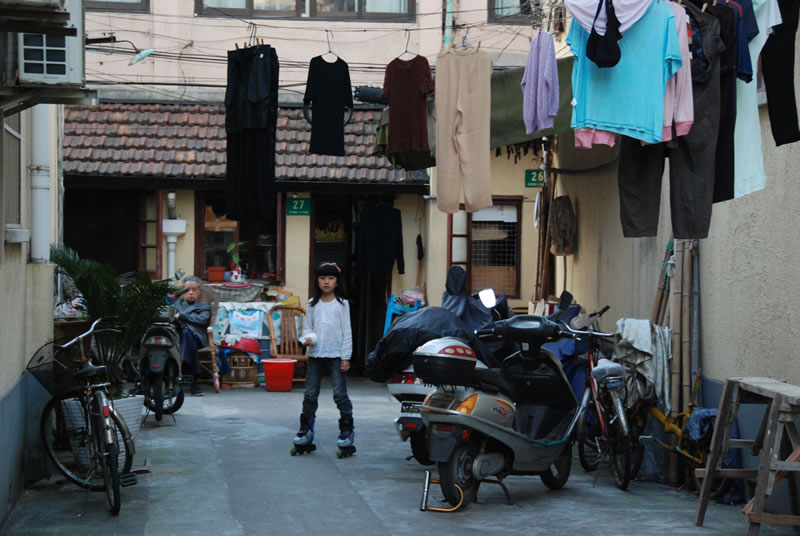
I have been in and out of Shanghai, but in the past year I have moved into an old lane house in the French Concession. The old lane houses in Shanghai are called ‘Nongtang’ (弄堂), which are really small lanes that extend from the main road into an area of low-storied houses. These clusters of houses are grouped by a unit number, such as 12′Nong’, and they have a gate and a security guard assigned to each Nong. Inside each Nong there is a a common rubbish area, in some Nongs there are common bath houses and common washrooms. The area inside each Nong is lively, because they understand that the people who live within the gates are all neighbours, and so they put out their stuff freely, hanging clothes and plants. They also tend to take out their chairs in Summer, the old people mostly, sit around and chat or play mahjong in the sun or at night, or letting their dogs play with each other. Even though I have only lived here for a year, I already start to recognize most of their faces since I get to see them more than I did back in my HDB flat in Toa Payoh, and for them mine. There is a sense of looking out for each other within each Nong, as some thieves tried to steal my bike before, and my neighbour’s dog barked and another neighbour also caught someone suspicious in the area and saved my bike. Once, an old lady’s son came to knock on her door but no one answered even though he could hear the TV from outside, and he was worried that the worst might have happened, and so started banging away at the door for her to open up. It was late at night and it stirred the entire Nong, who all came out to find out what’s happening and if they could help, which they did. My neighbour downstairs, who is an old ayi, took a long bamboo stick and started knocking on that lady’s window. Fortunately the old lady woke up and opened the door, and everyone had a sense of relief. I would never have had such an experience in Singapore. Nothing so human.
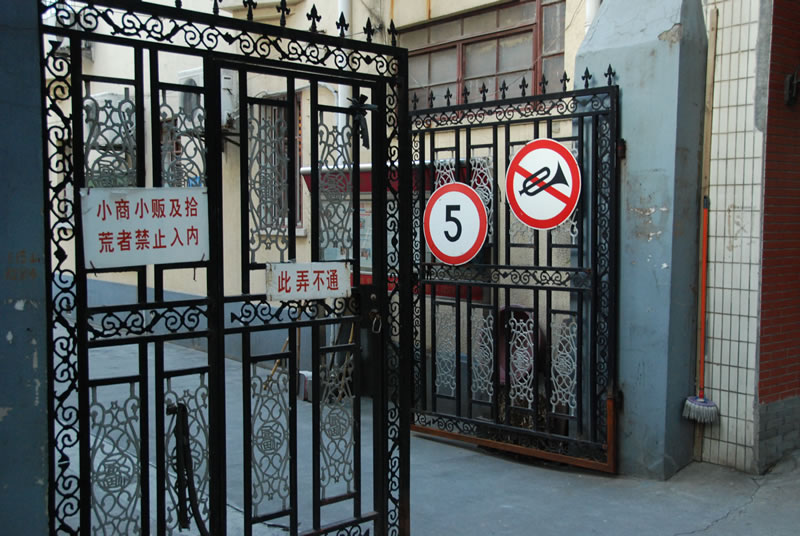

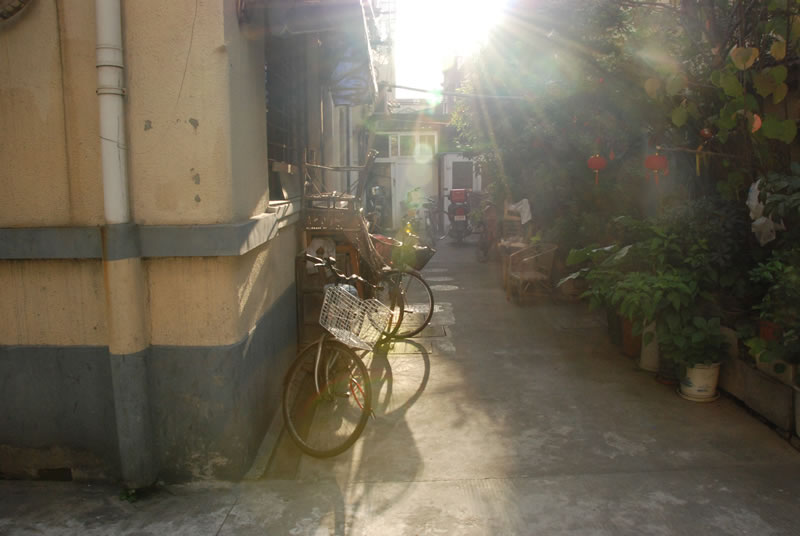

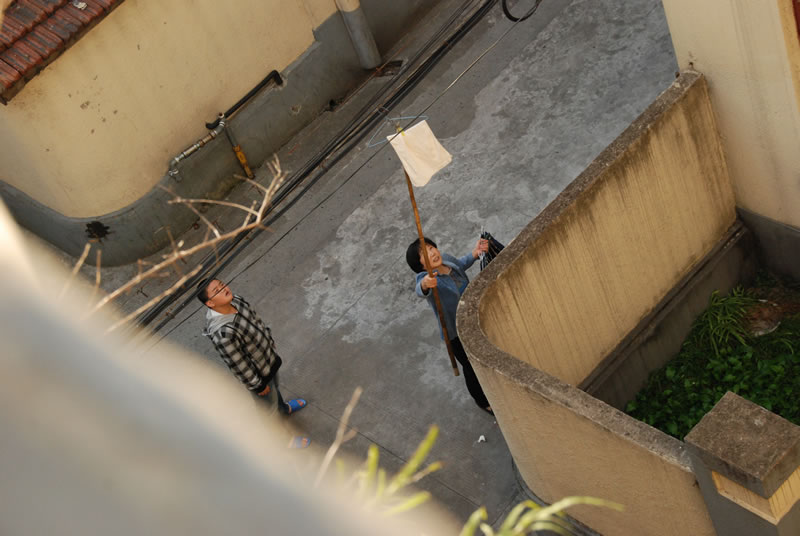
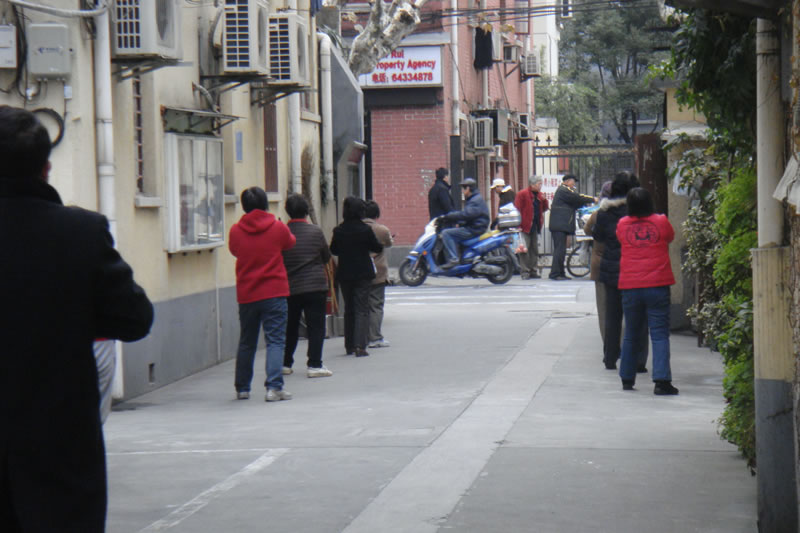
What does all this mean and what am I saying? I just feel that if Singapore wants to create a communal society, where people look out for each other and are not just selfish and think about themselves, and where people feel like they belong to where they live, then something ought to be changed. The interaction between residents needs to be facilitated through urban planning and design, even in the details at the very bottom level, like the mailboxes. Could we humanize them? Instead of just numbers, could we have a blank where people could write their family names or welcome messages or even draw pictures? There is a stark contrast between living in Singapore and anywhere else, and it is the lack of humanity. Do we really need void decks? At the end of the day, they become spaces for people to park their bikes or for kids to play soccer, which aren’t that bad, but weren’t the point of them to begin with. Their ‘repurpose’ came from the people living there themselves, finding use in a space that was left wasted. Quite often now, soccer is even banned from those void decks in fear of hurting someone. Everything in Singapore is duly organized, sectioned off piece by piece, in their places where ‘they should be’. If you want to do sports, take it to the stadium or the community centre. If you want to buy something, go to the centralized malls. Life is separated into compartments, with gaps in between; gaps that are wasted and lifeless, but worst of all, gaps that make residential life disconnected. Why can’t we have a cafe in the void decks? Or a late night movie screening where everyone is invited? Why can’t the walkways between school and HDB flats be filled with small little stalls or shops or games? It’s almost more interesting if you are forced to walk through something to get to another place, because it forces interaction and people are aware of their surroundings. What if you had to walk through a flea market or a bunch of people pracitising taichi everytime you want to get home? Wouldn’t that be more interesting?
In my place in Shanghai, because these old houses used to be a single unit, but were split up into 3 units after the war, I have to walk through my neighbour’s kitchen everytime I want to get home ( I live on the third floor). At first I thought it was annoying, but then I realized how interesting it is as I had to walk through their home everytime, and I would greet the old ayi and her family and her dog everytime I came home. And they would greet me back too.
I never got this in Singapore. And I had lived in the same place for 21 years.
]]>Now, as such, I have been fighting this notion since my school days. I have hated the idea of a person having split personalities, and especially one that is temporal and only resumes after every few months. It is an illusion of an identity, and some people might even tell themselves that that is real during the holidays and that their work days are actually an illusion to cope with the tragedy. I have sought to resist the duality, and sought to be a singular entity in which I am the same person during work and during play, and thus no such thing as holidays. Of course this is met with much difficulty, firstly having to find work that you accept as part of your identity, and secondly pleasure that you can define as work. It is not an easy goal, and probably frowned at with most disciplines, especially that of an engineer or professions that are less humane; who wants to be doing that all the time and deriving pleasure from cold boring work? I know some people who clearly want to distinguish work and play, and they deem such an approach as an organized life, and also a dutiful one.
So why my resistance towards this idea of a dual personality? Here I will be making an argument. I believe that split personalities are unsustainable and fake, and only by having one singular identity to see you through life will you be able to realize your true self. I’m not sure how long people can keep up with the split personalities, as I believe sooner or later, the stronger one will swallow the weaker, and having more days at work then at play, it is usually the labourer that prevails, even though the holiday-maker struggles fiercely his entire life. But I refuse to let society define our roles like that, I believe there is another way to live. Everyday should be the same, in the sense that, you do not change no matter what the seasons are. If you are an artist, or a scientist, you do not stop making art or investigating nature whether you are at work or out in the beach during Easter. That identity of yours is so deeply embedded in you in your bones that you can never brush it off with just a mere social thing called a holiday. Only by attaining that sort of identity will we be able to find our own true identities, and not one that is defined by a salary-paying job, or by society, or by people. It should be a role that you would still assume even when no one’s looking. Because it is you.
Because the Muse in you knows there is no such thing as holidays.
]]>
Revolution means so many different things to so many different people. To some, it is only a change in government. To Madame Soong, it was a change in the people and how they saw themselves, how they defined themselves, ideologically and socially. Perhaps it should be renamed Social Revolution, because very often governments change but the people don’t, and everything remains the same even though the ‘packaging’ is different. The question is, did Madame Soong’s Social Revolution succeed? Has the Chinese people changed their perception of China and of themselves as a nation and a civilization?
Now, I’m not interested in going into the details about Mao and his cultural revolution and whether that had anything to do with preventing true social revolution from happening, but I’m going to talk about things as they are, without assigning blame to anyone or to any entity. The fact is that China is far too complex a civilization to assign blame to just one party; it will always be a combination of factors, whether internal or external.
So, what is the state of the Chinese people now?
If you ask outsiders, they will tell you their impressions of most mainland Chinese as sometimes rude, not knowing basic manners, not understanding social etiquette, and not very polite. Of course, this is a general statement and does not apply to everyone in mainland China, but here we are dealing with a general impression and a large sample size within this huge population. Does this have to do with poverty? You do see a lot of rich Chinese businessmen who are a little loud and rough. In fact a lot of them can be quite rude in their mannerisms, and quite selfish and inconsiderate in their daily actions. So that rules out money as a factor. How is it that you can have so many people not feeling disgusted about spitting in public, and not feeling bad about cutting queue, and not feeling impolite to push and shove someone else in public if they are in your way? Why is this decline in social behaviour so apparent in mainland China, even though people are starting to become well-off and they have been opened to the outside world for about 20 years now?
You can’t say the Communists didn’t try to create good behaviour among their citizens. There have been countless of red banners with doctrines of good behaviour plastered all around China for centuries. But people tend to ignore them as noise no one ever really pays attention to them. It has become government propaganda now, instead of a good-will service to its people. So what is it? Is this actually the stubbornness of Chinese culture, which has prevented them from being brainwashed by countless different dynasties and different cultures and allowed them to withstand any sort of cultural invasion to preserve their own identity and values? Does this mean the Chinese people have always been rude? Now, let’s not jump to conclusions yet, as all these are still hypothetical, but they are possibilities.
And yet, China was the civilization that created the culture of politeness and rituals, thanks to Confucius, which became adopted by so many other cultures, such as Japan and Korea. How has Japan succeeded in creating good social behaviour? Why have they succeeded when China has failed, or should I say, not yet succeeded (if they are even trying in the first place)? I believe a big part of it lies in the education, although once again, there are many other factors, such as the social framework and the acceptance of bad behavior, or should I say, the lack of awareness of it. I am aware that this might start to sound like ‘the white man’s burden’ sort of thing, but for one, I am not white, and two, I believe the Chinese people themselves consider it as bad behaviour too, just that they put up with it and ignore it over time.
Did the revolutionary leader accidentally leave out this detail in their painful struggles for China? I know Sun Yatsen was all about how the people should be governed, and the freedom to vote for your own government. And when Mao came, he seemed to be more concerned about mobilizing the farmers and the workers, and distributing food and resources, and building the country up industrially. Then when Deng Xiaoping came, he seemed only concerned to let China became rich and powerful, increasing the opportunities in financial growth of the whole nation. Every step was essential, and you needed them to get to the next stage of progress. But what of the country culturally and socially? I believe Lu Xun was one of the few that actually cared about the country’s moral illness, which was why he put down his scalpel and took up his pen to try to cure it. But was it enough?
It is more than obvious that the next stage of Chinese revolution, if you want to call it a revolution to continue the pattern over the past century, would be a cultural one. Not like Mao’s cultural revolution, which I’d rather call a cultural destruction. But a revolution that would awake the Chinese people’s hearts and minds and make them realize what they have been missing all those years, and how they have been living blindly without any sense of social etiquette. That would be a true revolution, and a good one without causing the deaths of any, but a cultural renaissance, as Daniel likes to put it, where the arts would flourish and the people respected by foreigners as the upholders of the origin of civility.
Even when you look at Chinese calligraphy, it attempts to teach one how to live a proper and balanced life of good morals and social etiquette by walking up straight and not with a slanted back, which is translated through writing upright and visually balanced characters. This is embedded within Chinese writing and calligraphy although I’m not sure how much of that is still taught and believed in schools today.
]]>Our conversation then led to what it really means to ‘help’ these kids, and what it really means to ‘modernize’ someone, or a village. I brought up the thought that when you ‘modernize’ something, at the same time, you are also destroying existing culture, and this is how a lot of tribal culture is being made non-existent. My friend tried to rationalize this aspect by saying perhaps as beautiful as certain cultures are, it is inevitable that they do not survive if they cannot keep up with the times, or not tolerate cultures from the outside world. He started thinking if there is a point in preserving cultures that aren’t strong enough to survive the outside world. I mentioned that, well, we have zoos, which preserve and protect animals that may very well be extinct in our world today. I’m not sure if there is a point, as, the longer you keep them in the zoo, the longer they won’t survive outside in the ‘real’ world. But then i also mentioned that museums are also like cultural zoos in which they preserve culture that has otherwise been overwhelmed by globalization, and he quite liked the idea.
All this brought me to the thought of how the industrial revolution and technology has changed the world so much today to endanger cultures everywhere in the world. How are cultures endangered? When boundaries are erased and cultures exposed to each other, it brings them into a conflict and threatens their existence. A simple example of an influx of immigrants to a certain country makes the locals feel threatened very easily, overwhelmed by the foreign language and culture. In the old world, we had all sorts of boundaries: political, social, geographical, technological, linguistic, etc. But in the new world, everything is getting homogenized, and everything brought closer to each other, everything more accessible. At initial thought, that sounds great and all, unifying the whole world into one species. But then if you go deeper into it, you are essentially smearing all the colours on the palette to create grey. Without boundaries, many things will not survive. Deers could survive because they could hide or live in areas that were perhaps inaccessible to lions. But if the only boundary that kept them alive was taken away, they’d be extinct immediately. Being intolerable to the outside world doesn’t signify that a culture or a species shouldn’t exist, contrary to what my friend thought. It’s really the changing world that is erasing these boundaries that used to protect different species and cultures. Or should I say, enable different cultures to propagate and grow. If we didn’t have physical boundaries, we wouldn’t have so many different types of flowers in so many different colours. Flowers that aren’t strong enough to compete with other flowers don’t warrant their extinction. Unless we really want just one big bowl of cultural soup in a single flavour, we should really start thinking about what boundaries we are destroying everyday and what new boundaries are being created. These boundaries will break or make the future.
]]>By contrast, Country Driving, published in the U.S. in 2010, is more natural, unadorned and restrained. On the whole, it skirts the dirt of politics, dealing instead with issues that strictly speaking aren’t considered to have traditional news value. Hessler relentlessly explores China’s depths, where the silence is so profound it is deafening. It is precisely because he uses no convenient labels or signposts that the essence of this book, which was originally written for the English-speaking world, can perhaps ultimately only be appreciated by a Chinese readership.
After reading reviews of this book in The New York Times, The Washington Post, The Guardian, The Economist and more than a dozen other media, I felt that I might as well not have read them at all. When you first pick up Country Driving there’s the danger that you might mistake it for a book about driving culture or a “road trip” book. One by one, those foreign book reviewers fell into this trap. Peter Hessler himself participated in setting it up. At a lecture for the Asia Society in the U.S., Hessler selected some Chinese driving test questions, featured in the book, and turned them into slides for the talk. For example:
352. If another motorist stops you to ask directions, you should
• A not tell him.
• B reply patiently and accurately.
• C tell him the wrong way.
The U.S. audience saw this and burst into laughter. Civilized people are generous and, in situations like these where a little goodwill isn’t going to make anyone uncomfortable, they laughed, finding humor in the overly-analytical eastern mind. Nonetheless, this kind of humor which stems from cultural differences, however innocuous, is still shallow and, ultimately, unnecessary. On the whole, it distracts from the focus of the book. Its flippancy dilutes Country Driving’s deeper undertones. I don’t believe that I am totally incapable of understanding and appreciating humor. Hessler’s deadpan sense of humor, the so-called dry sense of humor, is clearly evident, but shouldn’t we expect all American non-fiction writers to have this sense of humor? The difference between Hessler and those other now well-known travel writers is not Peter Hessler’s sense of humor, but rather the degree to which he gets entwined with Chinese people, on both a practical and an emotional level.
Indeed, once the car has completed the long, dusty journey that is Country Driving, it would be better described as the thread rather than the theme of the book. It’s a little bit like a necklace: the focus should be on the beads that make up the necklace, rather than on the string that holds them together. If everything that is written about the car is nothing more than the lid of a trap then what is this book really about; in other words, what exactly are the beads that form the necklace? This question is not as easy to answer as it might first appear.
From a structural point of view, the three sections of Country Driving – The Wall, The Village, and The Factory – seem to be in balance, but actually there are enormous differences between the points of departure and the degree of emotional investment in each one. The first part, Hessler’s expedition along the Great Wall, is written using a similar architecture to that of Oracle Bones. Both books employ symbolic Chinese cultural objects as a medium, hoping to use these to measure the evolutionary pulse between the ancient and modern, and add the dimension of time to observations on China. The problem is that these over-simplistic attempts cannot find an echo in the realities of contemporary China. In fact, as Hessler heads west along the ruins of the Great Wall, his experiences lack consistency because his route is mechanical and pre-determined. At Genghis Khan’s tomb he encounters three inebriated cadres who had been at a luncheon banquet and observes them as they tenaciously try to bargain with the ticket collector at the door; at a cheap hostel for truck drivers in Gansu province he learns that in an upstairs room there lives a “post-Soviet version of Sister Carrie” – a Russian prostitute; and at a roadside restaurant in Zhangjiakou he meets a female boss who claims to be the “United Sources of America Inc., Deputy Director of Operations.”… and while these may still be considered interesting snapshots of contemporary China, they have no essential connection with the Great Wall. If Hessler were to arbitrarily choose another route from Beijing to Gansu, he would be just as likely to encounter many of the same things. The Great Wall, this important symbol of Chinese culture, is already entirely disconnected from the realities of today’s China. Country Driving expresses this point fully and convincingly, but surely it’s not worth spending 100 plus pages doing it?
Even though the objectives he sets up may not be practical, Hessler relies on his sharp observation to overcome limitations. The observations he makes, or more accurately, the observations he makes of society, are of two kinds – those that are evident and those that are hidden from view. For an example of the first kind, we can turn to the section where he discusses hiring a car from ‘Capital Motors’: “They never asked where I was taking the Jeep Cherokee. The rental contract specifically forbade drivers from leaving the Beijing region, but I decided to ignore this rule – they wouldn’t figure it out until I returned the jeep with a loaded odometer. In China, much of life involves skirting regulations, and one of the basic truths is that forgiveness comes easier than permission.” On the original English edition that I read on a Kindle, 59 people had already underlined that last sentence. Clearly, those readers were deeply impressed by Hessler’s ability to grasp social norms and models. However, I am more interested in his more subtle observations, which cannot be upheld as judgments, or classified as aphorisms. While driving through Shanxi and Inner Mongolia, it becomes Hessler’s habit to pick up hitchhikers, who turn out to be mostly young women: “… girls who had left the village and were on their way to becoming something else. They were well dressed, often in skirts and heels… They wore… cheap perfume… Invariably they were migrants on a home visit. They worked in factories, in restaurants, in hair salons, and they didn’t say much about these jobs. At first, I couldn’t figure out why there were so many women because in fact the majority of Chinese migrants are male. But this wasn’t a peak travel season… The people I met generally worked closer to home, in provincial cities or good-sized townships. For them, village trips were feasible, and women were more likely to make the effort, because they were attentive to parents and grandparents. When I asked about their packages, they said: ‘Gifts’.” Actually, Hessler blends some explanation for this phenomenon into his narrative. For example, if we go one layer deeper we can analyze further. Firstly, the adult male labor force is extracted from rural areas and this causes a gender imbalance in the countryside; secondly, because of ethical considerations, some young female migrant workers choose to work at a location not too far from their home village; thirdly, the nature of their employment offers the women the chance to visit their families during those holidays other than Spring Festival; fourthly, these women choose to walk at least a part of the journey back home because transport is inconvenient or because of economic considerations. Perhaps we could carry on and analyze this still further, right down to dissecting Chinese society to the most fundamental and microscopic level, but actually this is already deep enough. The observation of these female hitchhikers, seemingly unremarkable in itself, brings together and intertwines many significant and disparate facets of society, from the flow of China’s migrant population, family ethics, working traits, to transportation choices. Because of this, it is very difficult for us to draw a simple conclusion from this observation. Compared with those sections where Hessler discusses why Chinese drivers drive so willfully or why parts of the ruins of the Great Wall are now buried under dirt, his observations of the hitchhikers is a much richer source of information for a Chinese urban readership. This is inevitably the result of a difference in focus between Chinese- and English-speaking readers.
It’s inevitable that, while on the road and following a fixed itinerary, experiences tend to flash by; the traveler doesn’t have time to build up close emotional connections with the people he meets along the way. However, once we get to the second part of Country Driving, the emotional intensity rises sharply. This is because Hessler chooses a fixed location and, with enormous patience, cultivates and maintains a relationship with the place. Later on, this relationship is turned rapidly on its head, with an intensity that probably even surprised Hessler himself.
In 2002, Hessler and an American female friend, Mimi Kuo, rented a country home in a village called Sancha in the foothills of the Yan Mountain range. Although it was only about an hour or two’s drive from Beijing, it was surprisingly behind the times. Some of the book’s richest and most lyrical passages come from his descriptions of Sancha. Among these is an entrancing paragraph, where Hessler recounts how he went picking walnuts with some villagers, lashing the trees’ branches with sticks: “there’s a beauty to the shifting sound and light: the whistling sticks, the fresh leaves floating through the air, the walnuts thudding heavily into the dirt. After it’s over the trees seem to sigh – branches hum softly, still vibrating with the memory of the assault.” However, such tranquility and harmony was to last for only a brief interlude. Just then, Hessler witnesses the petty wrangling of village politics; the enormous impact of the rising tourism on villagers’ lives; and the intense effect of urbanization on the way the villagers thought. “It was all but impossible for people to keep their bearings in a country that changed so fast.”
The story of Sancha revolves around a middle-aged villager surnamed Wei. This intelligent man, dissatisfied with his situation, employs a highly individualistic approach, seizing business opportunities, joining the Party, buying a second-hand car, and fighting for an allowance for his mentally-retarded older brother, although in this he is finally defeated by the village party secretary. Hessler uses Wei and his family to paint an exquisite portrayal of the economictransition, social conflicts, the politics, customs, religion, and emotional relationships in China’srural north. From some angles, it can be regarded as an anthropological study. It’s only when he is with Wei’s young son that Hessler’s feelings begin to seep into his writing, causing him to transgress the detachment required of an anthropologist. The little boy suffers from idiopathic thrombocytopenic purpura and Hessler does everything in his power to help him. He consults with three U.S.-based specialists on the boy’s diagnosis; asks Mimi Kuo to organize for a bed in a top Beijing hospital; and discusses buying blood for the boy via an American contact who works for a pharmaceutical company in Beijing. Hessler angers the doctor in the Beijing hospital by querying the safety of the blood. When he suggests that the blood should be tested for viruses, the doctor replies: “Believe me, you can’t!” Hessler writes: “It disgusted me to hear a doctor say such nonsense.” He shakes with anger. In the book’s entirety, this is the only time that Hessler loses control of his emotions. From this, we can infer the depth of feeling between Hessler and this little boy. However, even more than this, at the exact moment he loses control, we are given the chance to read a realistic account of how an American would handle such a situation, and at the same time it allows us to see to what extent Hessler’s outsider status influences the fate of the people he writes about. This child is very lucky, not only because there is a person who cares about his health, but because that person has the ability to mobilize resources which the average person cannot. The issue is that at that critical juncture, Hessler’s first thought is to use his contacts instead of following the rules. Of course, such a kind impulse is understandable, even moving, but when Hessler mocks drivers on wChina’s highways who do not obey traffic regulations, does he ever consider that there might be a deeper institutional background as to why Chinese people are unwilling to follow rules? In China, what determines whether someone decides to first use their connections rather than abiding by regulations? Why, at that critical moment, does Hessler fail to follow the sacred American value of integrity? These questions are more worthy of our serious thought than the spontaneous expression of one person’s kindness.
If we say that the Sancha narrative is closer to Hessler’s style in his first book, River Town, then Country Driving’s third part, namely the section that centers on Lishui in Zhejiang province, allows Hessler to really bring his strengths into play. On one level, he acts just like a novelist, choosing a base from which to build up close relationships with other people, and meticulously describing everything. On another level, he is like a journalist, traveling all around the area, capturing fragments of life in order to substantiate and enrich his partial understanding of the place and, to a certain extent, to build and perfect a bigger picture from these snapshots.
It is on the side of a road that Hessler first meets the boss of a private enterprise in Lishui specializing in making bra-strap adjustment rings. Thereafter he often visits the factory, eating and living with the staff. He gets involved with the factory preparations, the installation of equipment, the production launch, and the factory’s relocation. His intense level of interest in the factory even causes the boss to go so far as to suspect at one point that Hessler is “an undercover competitor”. Hessler gives his readers, as The Economist book review puts it, the chance to be “a fly on the wall” and observe their every move and word. Here, Hessler takes our breath away by recounting the subtle twists and turns of human nature and the different shapes and shades of that society. We cannot help but admit that this is the first time we have read such a profound depiction of factory workers in contemporary China.
Whatever way we choose to summarize this section, it is inevitable that we will sacrifice some richness of detail, and it’s precisely that detail that is the most precious component of the narrative. I would just like to talk about what struck me the most, that is the alienation of workers from their work, and how work has become disassociated from the worker. Fifteen-year old Tao Yufeng, a female employee at the bra ring factory, is very nimble with her hands. She handles the bras’ underwire. “She wore a thimble on her left thumb, and the metal clicked each time she inserted another wire into the spring. Clickclickclickclick – the sounds came steady as a metronome, as fast as I could count. One afternoon, I watched Yufeng prepare thousands of wires… often she worked 10 hours straight on a single breast size. She could answer my questions without pausing or looking up.” Tao Yufeng says: “To be honest, I often have a peaceful feeling. I work alone and there’s nobody to bother me. I don’t think about anything in particular. If I try to think about something specific, then I don’t work as fast. So I just try to keep my mind empty.” It is difficult to say exactly how bad these working conditions are, but I feel that there is something suffocating behind the serenity. At a local artists’ workshop which copies American and European paintings and exports them overseas, Hessler asks a female painter: “Did you like to draw when you were little?” She curtly replies: “No, I didn’t like it one bit.” Hessler writes: “She never painted anything for fun – when I mentioned the possibility, she looked at me like I was crazy… I asked which of her paintings she liked best, and she said, ‘I don’t like any of them.’ She had a similar response when I inquired if she admired the work of any famous artists, like Monet and Van Gogh. ‘I don’t have a favorite,’ she said. ‘That kind of art has no connection at all with what we do.’ ” There is no more vivid expression of “alienation” than this. There has been a great deal of discussion on the many different costs incurred during the course of China’s modernization, but one cost, the alienation of people, has seldom been raised. If emptiness is the result of modernization then what is the point of modernization at all?
Hessler paints many delicate portrayals of this emptiness in people’s lives and in society. His conclusions are frequently so accurate that they are heartbreaking. “In a Chinese boomtown, though, it’s all business: factories and construction supplies, and cell phone shops… entertainment options appear instantly but social organizations are rare. No private newspapers, no independent labor unions… Religion might flourish at the individual level, but institutions are weak… There weren’t any law firms or nonprofit organizations. Police and government cadres were almost as rare… ” Hessler points out that some Chinese people have become good at making plans and adjusting their lives “but it would take another major step for such personal lessons to be applied to society-wide issues,” “often I sensed that China needed to reach a point where the middle and upper classes felt like the system prevented them from succeeding.” Is China anywhere near to developing to this point? Do the middle and upper classes already have this feeling? Perhaps it’s not difficult to answer this question; we just need to understand that it won’t necessarily do any good to speak it out aloud.
The Pareto improvement may be considered the ideal model of social evolution. This is one where any change benefits at least one person in society and harms no one. However, China’s many changes, especially those that have taken place in the countryside, are not the kind of changes to inspire optimism whatever way you look at them. They have harmed many people while the minority, who have benefited, don’t live in the countryside. No one but the company bosses and the developers is clapping for joy, while the rural population physically shoulders these almost unendurable tumultuous changes. Who should be made accountable for these developments and provide proof of their legitimacy?
Sometimes Hessler can’t help a certain dispirited tone: “In a drive-by town, I felt like a drive-by journalist, listening to sad stories before I got back on the expressway.” The problem is Hessler can leave, whereas we cannot. When we read Hessler’s book is it in order to comprehend this place, understand this place, change this place, or to say, don’t let this place change in the same way?
Even if you know that in the Chinese translation almost three pages of content beginning with the second paragraph on page 194 has been deleted; even if you know that much of the book’s language has been quietly made more moderate; even if you know that several of the sentences have been translated incorrectly; you should still be thankful that this book was published in China. Our first thanks should go to the author – Peter Hessler, a great China watcher and a long-time friend of the Chinese people. As for who is included and who is not included by the words “Chinese people”… I think you know.
Translated by Lucy Johnston
via http://en.chutzpahmagazine.com.cn/EnMagazineTextDetails.aspx?id=62
]]>
China’s national language is known by a variety of names. Called “Mandarin” or “modern standard Chinese” in English, it is officially known as Putonghua (普通话, “common speech”) on the mainland and guoyu (国语, “national language”) in Taiwan. Chinese in general is called hanyu (汉语, “Han language”), which in casual speech often refers to mainstream Mandarin.
The identification of this term with the Han, China’s majority ethnic group, is detrimental to national unity, argues Zhang Wenmu in an essay published in the Global Times last October. The author, a professor at the Centre for Strategic Studies, Beijing University of Aeronautics & Astronautics, studies national security strategy and writes frequently for the Global Times on national security issues. He proposed that China abandon hanyu in favor of a broader term that will better represent its status as the country’s “national strategic language.”
The essay, translated below, is one preliminary result of a grant program at the Shanghai International Studies University to study foreign language development strategy.
Fashioning China’s National Strategic Language
By Zhang Wenmu / GT
An important mark of a modern state, once its peoples have agreed to join together to establish a state, is that from a legal standpoint, clan authority is subordinate to state authority, ethnic self-determination is subordinate to state sovereignty, and ethnic dialects have given way to a national language. A national language is the language in common use by the citizens; dialects are languages in common use by different ethnic groups or regions within the country. Elevating the language of the public from a dialect to a national language is an important sign of the existence of state sovereignty.
The destiny of the state determines the destiny of its people, and the destiny of the people is the destiny of their language. Many languages have been buried in history, and if our focus in language studies is only on details like phonemes and syllables, if we do not pay attention to the life of the language and related political factors, then our research has lost all genuine meaning. If we wish for the world to know and understand China, as we promote the national language, we must step up the formation of China’s strategic language and its use on a world stage.
Here, I would recommend that the concept of a “Chinese language” (中国语, Zhōngguó yǔ) be used in place of “Han language” (汉语, Hànyǔ), and with this as a starting point, shape a national strategic language that occupies a higher position than other ethnic and regional dialects. My reasons are as follows:
First, the use of “Chinese language” is advantageous to national identity. For China’s social governance amid periods of national transition, it has a particularly large and crucial political significance. During the Republican period, the national government once promoted a “national language” (国语, Guóyǔ); after the founding of New China, the central government promoted “common speech” (普通话, Pǔtōnghuà). These were all effective practices that shaped a national strategic language and elevated the national identity of all citizens. “Chinese language” is of course the strategic language that contemporary China must devote major efforts to shape.
Second, the traditional Chinese concept of “Han language” gives prominence to ethnic identity but lacks a national identity. Before the founding of the People’s Republic of China, ethnic languages of particular regions did not possess an inevitable political connection; however, once a People’s Republic of China recognized by all ethnic groups was founded, different communities needed to have a unified national language, a “single script.”* Today, the term “Han language” is on equal footing with “Tibetan language,” “Uyghur language,” and other ethnic and regional languages too numerous to mention. This is at odds with the principles of national identity unanimously agreed upon when the country was founded by a multi-ethnic coalition. Under these principles, non-uniform national self-determination and ethnic identity gave way to unified state sovereignty and national identity. A “Chinese language” based on the “Han language” family can be fashioned to occupy a higher position domestically than the “dialects” of ethnic groups, and to express a uniform national strategic language recognized by all the people of China internationally.
Third, an excellent context already exists within the international community for the shaping of China’s national strategic language. For quite some time now, English has generally used the term “Chinese” to express the notion of the “Chinese language” for which ordinary Chinese use the term “Han language.” Chinese is defined in English as “the standard language of China, based on the speech of Beijing.” And for the terms “Han language” and “standard speech,” which are nearer to dialects in meaning, English uses “Mandarin” which is defined in English as “the major dialect spoken by a majority of the Chinese people.” Hence we too ought to use “Chinese language” in place of the “Han language” concept in mainstream TV, newspapers, and magazines for both domestic and foreign consumption.
It must be pointed out that fashioning a national strategic language elevated above the dialects does not imply that dialects must be wiped out. Corresponding language policies should include the preservation and enrichment of the diversity of dialects, and the protection and elevation of the primacy of the Chinese language.
When a country is founded, the creation of a principal language helps prevent domestic ethnic diversity from dissipating the unity of the country, an important experience that developed western countries have gained through their highly successful domestic governance. Just as the emphasis in “The United States of America” (美利坚合众国) is on “united” (合众), not “states” (众国), the emphasis in China’s concept of “ethnic regional autonomy” (民族区域自治) lies not in “ethnic” (民族) but in “regional” (区域). Modern state theory demonstrates that once sovereign states have been established, ethnic diversity exists only on the level of culture, not politics, with ethnic differences then falling under the scope of regional differences in geographical economics. In the scope of politics, civic principles replace ethnic principles, and diverse ethnic identities are transformed into an undifferentiated civic identity. By the same token, fashioning a strategic language for China—an undifferentiated “Chinese language”—does not imply eliminating diverse domestic ethnic characteristics, but means enhancing national unity upon a foundation of guaranteeing and further enriching ethnic diversity.
Zhang’s proposal was picked apart by Wang Dechun (王德春), a linguist and rhetorician at the Shanghai International Studies University, in the November 15 issue of the university’s newspaper. Wang took issue with Zhang’s brush-off of the linguistics discipline and his reference to a “Han language family,” and cited examples from the Soviet Union and the English speaking world to illustrate how a national language need not be artificially distinguished from ethnic languages.
Wang also questioned the importance of the national strategic language (国家战略语言) concept. Indeed, there do not seem to be many references to such a thing available online. Do other countries have national strategic languages which they deploy to promote national unity within the country and soft power on an international stage?
Notes
- Terms that appear in English in the original text have been rendered in italics in this translation.
- 书同文shū tong wén: The Records of the Grand Historian lists this, along with unifying axle widths, as one of Qin Shi Huang’s achievements, but it turns up in the earlier Doctrine of the Mean ascribed to Confucius (who adds a line about unified standards of conduct): “今天下车同轨,书同文,行同伦。”
- Global Times via Zhang Wenmu’s blog (Chinese): Fashioning China’s National Strategic Language (国家外语发展战略研究, 2010.10.27, p14)
- Shanghai International Studies University News (Chinese): A discussion of “national strategic language” (“国家战略语言”商榷, 2010.11.15, p4)
- The China Centre for Linguistic and Strategic Studies homepage
- Earlier on Danwei: Redefining the Great Wall
via http://www.danwei.org/language/chinas_national_strategic_lang.php
 Peimin Ni“Kung Fu”
Several years ago, I was invited for lunch by a man named Wu Bin, who was the former martial arts coach of the kung fu movie star Jet Li. Mr. Wu and I did not know each other, and I had no idea why he invited me for lunch. I was more puzzled when I got there — Mr. Wu insisted that I be seated in the most prominent spot, and placed himself and all his associates at the table in lesser positions. With the ritual setting in order, he then humbly presented me a classic martial arts manual, and asked if I could explain the introduction of the book for him. “It is full of philosophical terms,” he said. “I have trouble understanding it.”
I looked at the manual. It was on a martial arts style called xingyi quan. While the main body of the book was about postures and movements of the body and energy, which Mr. Wu had no trouble interpreting, the introduction was basically a treatise about metaphysics. It contained views derived from the Song dynasty neo-Confucian scholar Zhou Dunyi, in which an abstract concept, calledwuji, the ultimate non-being, takes a central role as ontologically prior to taiji (t’ai chi), or “the primordial ultimate.” Oddly enough, the author offered no indication about how the ideas should be translated into the martial arts, as if it were all self-evident.
Thanks to Mr. Wu’s practical background and drawing on my own philosophical training and experience in the practice of Chinese calligraphy art — a form of kung fu which is deeply influenced by traditional Chinese philosophy — it did not take me long to convey the basic ideas to him and help him see the intellectual connection between the metaphysics and the martial arts, though we both aware perfectly well that it would take lots of cultivation for the connection to be embodied and manifested in the practice. The point is basically to empty oneself (including the metaphysical idea), so that, paradoxically, one can achieve unification of the self and the world! Mr. Wu sighed, regretfully, “Today’s martial arts practitioners focus too much on the surface performances. That is not real kung fu!”
I share this story here is because a few commenters raised the question of whether my original post was denouncing the practical significance of the theoretical pursuit for truth, despite the fact that I wrote, “Philosophers’ ideas, even when theoretical, have never stopped functioning as guides to human life.” The misreading, however, made me aware that I need to give the other side of the practical-theoretical coin the weight that it deserves.
Even though, as I wrote in the first post, a menu should not be mistaken for food, this does not mean that the menu is worthless for getting food, nor does it entail the demand that everything that can serve as a menu must be created for the sake of getting food. What is “alarming” is not that some people like to think for thinking’s sake or purely for the search of truth; it is rather that when this way of doing philosophy becomes dominant, we tend to forget that there can be other ways of thinking and other values or implications of philosophizing. Just as Zhou Dunyi’s metaphysics can be taken as a guiding principle for xingyi quan, calligraphy, or any other kung fu defined in the broad way and not merely as a mirror of reality, virtually all philosophical ideas can inform human practice and have practical implications. Hence the relationship between kung fu and philosophy goes both ways: As much as we philosophers need to open our vision for the kung fu perspective, all forms of kung fu depend on philosophical ideas, one way or another. Whether good or bad, theories mold our patterns of behavior and even transform us. While attachment to conceptual truth will block one’s path toward higher levels of kung fu, so will a kung fu practitioner have trouble reaching higher stages of perfection if they lack good philosophical guidance, including proper conceptual resources.
Trying to obtain the truth and yet frustrated by the postmodern deconstruction of the project, many people today find themselves facing the dilemma of either embracing relativism or falling back to dogmatic absolutism. The kung fu approach helps us to see the instructional value of our apparently endless philosophical disputes. This is exactly why I propose the term “kung fu,” understood properly, as not only a guide toward more fruitful reading of traditional Chinese philosophy but also as an approach (though obviously not as the only approach) through which we can evaluate philosophies of all traditions.
We philosophers are proud of discovering hidden assumptions and often feel that we have beaten every bush and asked all the perennial questions that philosophers care to ask. But it does not take much reflection to realize that we devote a lot of attention to the pursuit of propositional truth and very little toward exploring the the transformation of the human subject. We have fields of study that bare some proximity to the subject, such as action theory andpraxiology, but one thing that may push these fields of study further is for us to move our focus from mere actions or praxis to kung fu — namely to the transformation and enabling of the human subject. Could the concept of “kung fu” link the practitioner to action in such a way that actions would no longer be treated merely as the result of rational choices or impulses or technical/managerial procedures, but also as the result of cultivation? Could it lead to a shift in our study of human actions and praxis similar to the one in ethics that resulted in a renewed interest in the moral agent? There is a lot of work to do.
Perhaps I did a fine job in helping Mr. Wu, but I can’t help feeling uneasy about the prominent seat that Mr. Wu had me sit in. We philosophers are wise more in the sense of knowing that we don’t know, but on the other hand, people like Mr. Wu look up to us for our guidance, and they have a good reason for that — because our philosophical ideas do matter.

Peimin Ni is professor of philosophy at Grand Valley State University. He currently serves as the president of the Society for Asian and Comparative Philosophyand is editor-in-chief of a book series on Chinese and comparative philosophy. His most recent book is “Confucius: Making the Way Great.”
via http://opinionator.blogs.nytimes.com/2010/12/21/philosophers-for-kung-fu-a-response/
]]>